In 2026, choosing an inverter is not just a matter of comparing wattage or price. Its output waveform can affect how appliances run, how much heat they produce, and whether sensitive electronics behave reliably. Pure sine wave output closely resembles utility power and suits many modern devices. Modified sine wave models may cost less, but can cause humming, extra heat, or poor performance with certain loads. The label alone is not enough.
Power-electronics educator Robert W. Erickson offers a useful lens through his published work: inverter performance depends on the interaction between the converter and its load. Rather than inventing a verbatim quotation, here is a clearly labeled paraphrase of that principle: “Choose the output for the load, not the label.” A refrigerator compressor, for example, places different demands on an inverter than a phone charger does. Small details matter.
This guide compares common Inverter Output types by waveform quality, compatibility, efficiency, and practical cost. It also explains where pure sine wave, modified sine wave, and other output options make sense. A quiet fan may reveal a mismatch before a specification sheet does. Real-world tests are useful, but they do not answer every question; models and loads vary. The best choice in 2026 is therefore the one that fits your equipment, operating conditions, and budget—with enough margin for startup surges. No single output type wins every time.
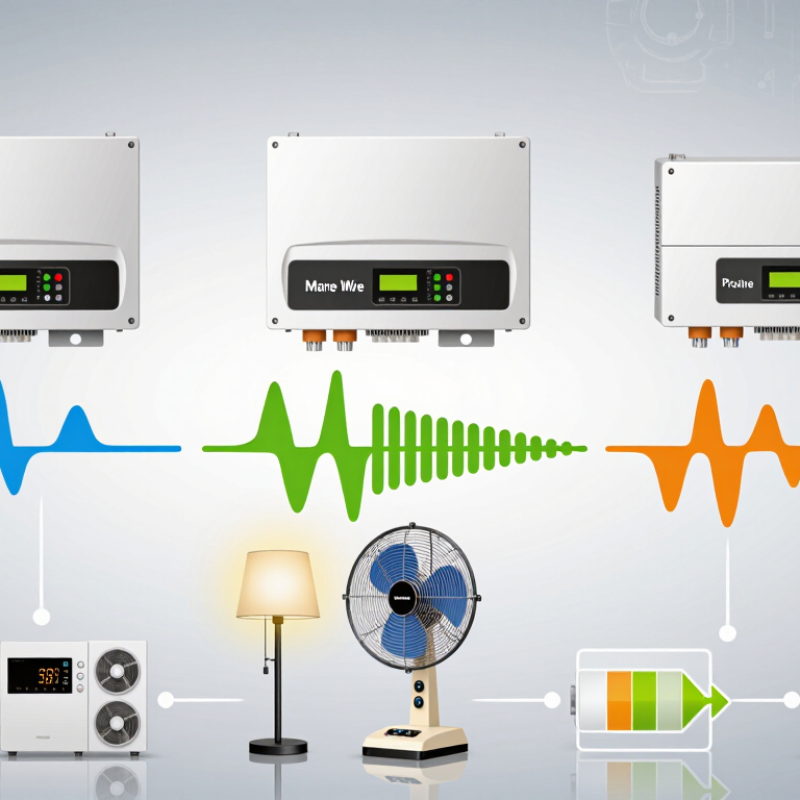
An inverter’s output waveform is commonly classified as square wave, modified sine wave, or pure sine wave. Square-wave output switches abruptly between voltage levels. Modified sine output uses steps, creating a waveform that only approximates a smooth sine curve. Pure sine output follows a smooth, repeating curve. That distinction matters. A stepped waveform may cause some motors to buzz, run warmer, or perform less efficiently. Sensitive equipment can also respond differently. On an oscilloscope, the shapes are easy to compare, but appearance alone does not reveal performance under load. I still find “pure sine” a little too neat as a label: distortion and voltage regulation matter, too.
For a measurable comparison, check total harmonic distortion (THD) and the connected load’s requirements. IEEE Std 519-2022 sets voltage distortion limits at the point of common coupling: for systems at or below 1 kV, total voltage THD is limited to 5%, with individual harmonics limited to 3%. These are system-level limits, not a guarantee that every inverter meets them at its output terminals. Ask for test conditions and results, including load level. A waveform can look clean at light load, then change when a compressor starts. That detail is easy to miss.
| Output type | Waveform classification | Typical compatibility | Potential limitations | Common use cases | Best fit |
|---|---|---|---|---|---|
| Pure sine wave | AC output closely approximates a smooth sinusoidal waveform. | Generally the broadest compatibility, including most household electronics, appliances, and equipment with AC motors or transformers. Always check the device manufacturer’s requirements. | Usually costs more than simpler waveform types. Output quality and total harmonic distortion (THD) vary by inverter; check the specifications for the intended load. | Homes, sensitive electronics, variable-speed equipment, audio systems, and mixed-load applications. | Best all-around choice when compatibility and predictable operation matter most. |
| Modified sine wave | A stepped waveform that approximates a sine wave, typically using multiple voltage levels rather than a smooth curve. | Many basic resistive loads and some compatible electronics can operate from it. Compatibility depends on the device and its power supply. | May cause extra heat, noise, reduced performance, or malfunction in some motors, transformers, clocks, and electronic equipment. Not suitable for a load unless its manufacturer permits this waveform. | Budget applications with simple loads confirmed to be compatible. | Consider only when the connected loads are known to work with a stepped output. |
| Square wave | A waveform that switches abruptly between positive and negative voltage levels, with little or no sinusoidal shaping. | Limited compatibility; appropriate only for simple loads specifically designed to accept this output. | Its abrupt transitions and harmonic content make it unsuitable for many modern appliances, motors, and electronic devices. | Niche or legacy applications with explicitly compatible equipment. | Rarely the practical choice for general-purpose household or mobile power. |
Selection note: “Pure sine wave” is generally the most versatile option, but no waveform guarantees compatibility with every device. Check the inverter’s output voltage, frequency, continuous and surge ratings, and THD, along with the connected equipment’s specifications. Nominal AC voltage and frequency depend on the region and inverter model.
Square-wave output switches abruptly between positive and negative voltage. Its edges are rich in harmonics; an ideal square wave has about 48.3% voltage total harmonic distortion, calculated from its Fourier series. Modified-sine-wave inverters soften those transitions with a few voltage steps. They can run simple resistive loads, such as a basic heater, but motors may buzz, run hotter, or lose efficiency. Some chargers and sensitive electronics may also behave unpredictably. The details matter: “modified sine” is not one standardized waveform.
Pure-sine-wave output more closely resembles utility power and is generally the safer choice for motors, audio equipment, and sensitive electronics. Check the device manual and the inverter’s measured output specifications, not just its label. IEEE 519-2022 sets a 5% voltage-THD limit at the point of common coupling for systems at or below 1 kV; that is a grid benchmark, not a guarantee for every standalone inverter. A useful distinction. In practice, waveform shape and load compatibility matter more than the name alone. I would not treat a low price or a “sine” claim as proof: published THD figures, test conditions, and load ratings can be easy to overlook.
In 2026, inverter output type still matters because appliances respond differently to different waveforms. A pure sine wave closely resembles household utility power. It is generally the safer choice for refrigerators, variable-speed motors, audio equipment, and devices with sensitive power supplies. A compressor may start more smoothly, while a fan motor can run with less hum. Check the inverter’s continuous and surge ratings too; waveform alone cannot guarantee a successful start. That matters.
Modified sine wave inverters can suit simpler loads, such as many incandescent lights and basic heating elements. But some motors may run hotter or noisier, and certain chargers, timers, or medical devices may behave unpredictably. The result depends on the appliance’s design, not just its label. I would check the manual and input requirements before connecting equipment, especially anything with a compressor or electronic speed control. Small details count.
For a real-world check, compare the appliance’s voltage and frequency requirements with the inverter output, then allow headroom for startup surges. A kettle and a refrigerator do not make equal demands, even if their running wattage looks similar. Pure sine output costs more in some setups, and it can be unnecessary for basic loads. Still, choosing by price alone is an easy mistake.
Which Inverter Output Type Is Best in 2026?
Which Inverter Output Type Fits Common Uses in 2026
For most everyday equipment, pure sine wave output is the safer fit. It closely resembles utility power and suits laptops, audio equipment, refrigerators, and many motor-driven tools. Modified sine wave models can cost less and may serve simple resistive loads, such as basic heaters or incandescent lamps. But some motors can run hotter or noisier on rougher waveforms. Compatibility varies.
IEEE 519-2022 sets an 8% voltage total harmonic distortion limit at the point of common coupling for systems rated at or below 1 kV. This is a grid-quality benchmark, not a direct pass-or-fail test for standalone inverters. Still, it highlights why waveform quality matters. Match the inverter’s continuous rating to the load, then check startup surge requirements; a refrigerator compressor may briefly demand more power than its running label suggests. A common mistake is sizing only for the average load.
Tips: Check appliance manuals for waveform requirements. For mixed household loads, pure sine wave output is usually the simpler choice. Leave room for startup surges, and verify the inverter’s actual output specifications. Real installations are not always tidy; cable length and battery limits can also affect performance.
Idealized output waveforms for three inverter types, shown over one electrical cycle on a nominal 120 V RMS system.
Choosing a type: Pure sine wave output is the most broadly compatible, including with many motors and sensitive electronics. Modified sine wave output may suit simpler loads, but some devices can run noisier or hotter. Square wave output is uncommon for modern general-purpose use and is incompatible with many devices. Waveforms shown are idealized examples; actual output varies by inverter.
Choose an inverter by matching its output to the equipment you need to run. Pure sine wave output closely resembles utility power and is usually the safer choice for refrigerators, pumps, medical equipment, and devices with motors or sensitive electronics. Modified sine wave models may cost less, but some equipment can buzz, run hotter, or fail to operate properly. Check each appliance’s manual rather than relying on wattage alone.
Sizing matters just as much. Add the running watts of the devices you’ll use together, then check the inverter’s surge rating for startup loads. A refrigerator may draw far more power for a few seconds when its compressor starts. IEEE 519-2022 sets an 8% voltage total harmonic distortion limit at the point of common coupling for systems up to 1 kV. That’s a useful grid-quality reference, not a pass/fail limit for a standalone inverter. I still check the maker’s test conditions; THD figures can be hard to compare.
Tips: Read the inverter’s continuous and surge ratings, output voltage, and frequency. For sensitive loads, look for a stated THD figure and a pure sine wave output. Leave some capacity in reserve. It’s easy to underestimate startup demand.